
Signal Saturday: The Genetic Echo - Heritability and the “Parent Gap”
Data reveals a 50% chance your parent is undiagnosed. Here is the science of the 'Double Hit' and how to break the cycle.
TL;DR:
• The Math: ADHD heritability (\bm{h^2}) is 0.70–0.80, placing it in the same genetic tier as height.
• The Probability: There is a 25% to 50% chance at least one of your parents is an undiagnosed ADHDer.
• The Interpretation: What we often perceive as parental “narcissism” is frequently calcified, untreated ADHD emotional dysregulation.
One of the most profound realisations for adults diagnosed in their 30s is the ‘Lightbulb Moment’ regarding their parents. As we gain the vocabulary for executive dysfunction and Rejection Sensitive Dysphoria (RSD), we begin to see these patterns in the very people who raised us.
However, when a parent lacks self-awareness, this leads to a Data Paradox: they possess the genes for ADHD but none of the tools to manage them, often resulting in a volatile environment for the neurodivergent child.
1. The Heritability Coefficient: \bm{h^2}
In quantitative genetics, heritability (\bm{h^2}) is a statistic used to estimate how much variation in a trait within a population is due to genetic differences rather than environmental factors.
Multiple meta-analyses of twin and adoption studies consistently place the heritability of ADHD at 0.70 to 0.80.
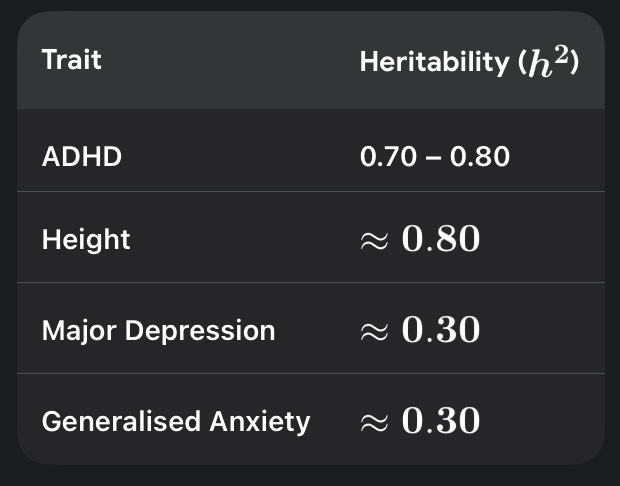
The Data Signal: If you are ADHD/AuDHD, there is a statistical probability of nearly 80% that your neurodivergence is a structural, genetic reality inherited from your lineage. It is not the result of ‘poor discipline’ or modern environment; it is your biological baseline.
2. The Parental Recurrence Rate
Research published in the Journal of the American Academy of Child & Adolescent Psychiatry indicates that if a child is diagnosed, there is a 25% to 50% chance a parent also meets the criteria.
For those of us in the ‘Lost Generation’ (diagnosed in adulthood), our parents were raising us in a Data Desert. During the 80s and 90s, ADHD was viewed strictly through the lens of hyperactive schoolboys. Consequently, many parents - particularly mothers - spent decades internalising their ‘chaos’ as character flaws.
Their subsequent emotional volatility or defensive ‘narcissistic’ traits are often the long-term result of a nervous system that has been redlining without support for 60 years.
Note for Subscribers: Below, we dive into the Gene-Environment Correlation (rGE)—the specific mechanism that explains why being raised by an undiagnosed parent creates a ‘Double Hit’ of trauma and biology
Upgrade to Paid to unlock the full technical breakdown and the ‘Break the Cycle’ roadmap.
Keep reading with a 7-day free trial
Subscribe to ADHDer.net to keep reading this post and get 7 days of free access to the full post archives.